

Today, most of us are driven by activities that bring us happiness or self-satisfaction. In pursuit of such happiness, we often tend to forget our psychological well-being and end up with a condition where we find ourselves stuck and heading nowhere. So many reasons contributing to it- a major one that I wish to talk about here is our ignorance towards considering the factors of psychological well-being. Well-being for us is narrowing down to medical or biological which, does not really, define happiness for a person. Our self-satisfaction, self-worth, motivation and actualization depend upon the level of our psychological well-being and not medical or biological ones.
Apart from studies made in older days, there have been some recent studies as well on psychological well-being, however not pondered much over it by general people. The volatile nature of the world around us is now pressing us to think and discuss our ultimate well-being and achieving true happiness. Through this article, I have tried my part in bringing this idea forward and let all know what is psychological well-being all about and what are the factors contributing to it. I have identified Carol Ryff’s six factors of well-being as the appropriate ones to give my interpretation.
Professor Carol Ryff, from the University of Wisconsin-Madison, has created the most scientifically and empirically verified model of Psychological well-being. She was driven by the question of what is meant by a ‘good life’, what contributes to it and helps to achieve it. She had prepared a set of questionnaire to gather data, analyze facts and identify motivations out of it. She believed that well-being is multi-dimensional and every other human being finds it in his/her way.
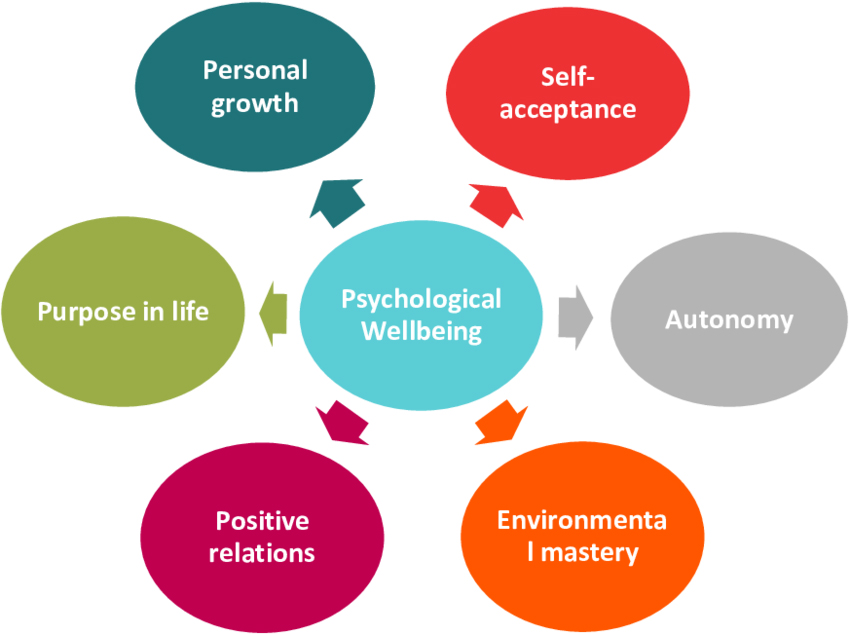
Let’s now look at the concept. There are six factors identified by Professor Ryff. They are self-acceptance, personal growth, purpose in life, positive relationship with others, environmental mastery and autonomy. These six factors, being either high or low in a person decides his-her psychological well-being. The questionnaire was prepared to measure these factors. Also, a person’s motivation; whether intrinsic or extrinsic; also factored in either having a virtuous content life or a superficially happy one.
How is this useful today? Why am I talking about it? Well, the answer is simple. The pace of our lives has increased significantly during the past decade and the steering control of it is stealthily moving out of our hands. Things that make us happy – are now mostly extrinsic. What I mean is that we are driven by external things that allure us and instigate us to run after them. We hardly listen to our inner self but move around the world to gather thing that we perceive would give us hedonic happiness. The fact still lays with the claim that the true feeling of happiness and satisfaction comes from intrinsic motivations, that is, from within. Hence, it is of utmost importance that we identify the core factors of well-being instead of trying to define them our way. Check yourself on the factors and see for yourself what would take you closer to your happiness and what all are making it difficult. As I said earlier, there’s a questionnaire which let us know our scores in each factor. Let’s quickly run through the six factors and see how they are critical to our lives:
- Self-acceptance: With a high score here, you accept your highs, lows, qualities and shortcomings. With a low score, it indicates that you are dissatisfied with yourself.
- Personal growth: With a high score here, you indicate a desire for self-improvement and refinement whilst a low score is an indication that you have a preference for the status quo and change for betterment does not excite you.
- A positive relationship with others: As it is very clear by now to understand what does a high and a low score here indicates. Sense of warmth, intimacy and trust in all the relationships around you with a good number of such relationships is indicative of your high score and a low score reflects fewer numbers of such interpersonal relationships.
- Autonomy: This factor is extremely crucial to one’s well-being. If you can lead your life on your terms by combating what people want you to do reveals that your autonomy scores are high. If you are submissive when it comes to leading life and taking decisions, you may expect a low score here. If you try to live up to others expectations more than anything else- time to give your autonomy a thought.
- Purpose in life: Do you have a purpose in life? Do you know what exactly you want out of life? I am not talking about your goals in life that you want to achieve for yourself. It’s about the existential (relating to one’s existence) purpose of life. If you are intrinsically driven; you would experience a high score. If these things that I’ve just mentioned do not apply to you- you possibly have a low score here.
- Environmental mastery: Can you sense the type of energy your surrounding environment holds? Can you identify the advantages your surrounding environment holds for you? Are you able to control an environment that is about to slip out of your hands? If all or any of these implies to you; your score here must be high and otherwise low- provided your responses are not ideal but honest.
Despite being such an important matter to consciously think about; there’s a shortcoming identified too. As the responses collected are completely based on one’s personal views- there’s a chance that the scores may not reflect the perfect state of well-being. If the respondent decides to opt for ideal answers instead of answering what truly relates to them; there’s a chance that scores are not indicative of a true state.
To conclude, Professor Carol Ryff’s model of psychological well-being can be a great tool for us to plan and live life better. We can have a look at the factors from time-to-time to evaluate if we are heading towards a purposeful life or not. Either refer to the six factors and see for yourself or click the link below to take the test to get your scores: https://sparqtools.org/mobility-measure/psychological-wellbeing-scale/
Go ahead! You have the key to unleash your true potential. All the best!